Editorial
Distribution's Biggest Opportunity
The visibility gap across the channel could be closed by the businesses with 75% of the cards
Fewer than 40% of vendors have a clear line of sight into partner-sourced pipeline and revenue when going through Distribution.
It’s a statistic that should give distribution leaders and the vendors and partners they serve a cause to pause. Not because it’s a surprising number, but because it reflects a structural issue many already sense but struggle to quantify.
Distribution sits at the centre of the channel. It connects vendors to partners, enables routes to market, and increasingly plays a role in funding and supporting campaign execution. On paper, that position should offer a comprehensive view of how demand is created and converted. In practice, for a lot of the time, it doesn’t.
The problem isn’t a lack of activity or even a lack of data. Distributors see campaign outputs, partner engagement, and vendor investment flowing through their systems. What remains unclear is the one thing that matters most: what is evidently driving revenue.
The problem starts with the disconnect from the buyer
Buying behaviour has changed, and it has changed decisively. The traditional, linear progression to purchase, neatly tracked through partner-led engagement, has largely disappeared. Today’s buyers move unpredictably, influenced by multiple touchpoints across digital, peer, and vendor-led environments. They arrive informed, often late in the process, and increasingly on their own terms.

The growth of marketplaces and SaaS consumption models has only accelerated this shift. Buyers can now research, validate, and purchase solutions with minimal partner interaction. In some cases, the partner is brought in after the decision has effectively been made. In others, they are bypassed entirely.
The blind spot is its biggest opportunity
While distributors continue to enable campaigns and provide the infrastructure for partner activation, they are often removed from the moments where intent forms and decisions are made. The result is a fragmented view of performance, one that tracks activity but struggles to attribute outcomes.
This is where the expectations placed on the channel begin to diverge from reality.
Vendors continue to demand measurable pipeline and demonstrable return on investment. Partners are expected to generate that pipeline, often with limited resources and increasing pressure to differentiate. Distribution, in turn, is expected to enable both by providing the tools, programmes, and support to keep the ecosystem moving.
Yet without a shared, end-to-end view of performance, these expectations are built on incomplete information.
Answering the most fundamental questions
It’s reasonable to ask when vendors are providing funding - which partners are genuinely contributing to growth? Where is demand forming, and why? Which investments are driving meaningful engagement, and which are simply generating noise?
Traditional models, built around periodic campaigns and isolated reporting, are not equipped to provide those answers. Nor are they designed for a buying environment that is continuous, non-linear, and increasingly self-directed.
Distribution's Evolution Revolution
The opportunity is not to replicate what vendors or partners are already doing, but to bridge the gap between them. To move beyond operational enablement and become the layer that connects investment, capability, and outcome.
That means developing a closer proximity to buyer behaviour; not just through aggregated data, but through consistent, real-world engagement. It means supporting partners with the infrastructure to remain present throughout the buying cycle, rather than appearing only at discrete campaign intervals. And critically, it means creating visibility that is shared across the ecosystem, not held in silos.
When done well, this shifts the distribution from a facilitator of activity to a driver of performance.
What's a partner enablement portal worth?
A final point of note is that many of the biggest distributors do a great deal to support their partners with extensive enablement portals so 'all' they need to do is go in, grab a campaign and get behind it. The reality is that partners do not invest in the skills, technology, and resources needed to do this long enough to match buying cycles. This results in huge amounts of wasted spend and resources - whether that's vendor funding, distribution support, or partner activity
Eyes on the Prize
The prize is significant. Greater clarity over where demand is forming. More effective allocation of vendor investment. Stronger alignment between partners and the opportunities they are best placed to pursue. And ultimately, a more predictable and measurable route to revenue.
The alternative is to continue operating with partial visibility in a market that no longer tolerates it.
For distribution leaders, the question is no longer whether this gap exists. It is whether they are prepared to close it, and in doing so, redefine the value they bring to the channel.
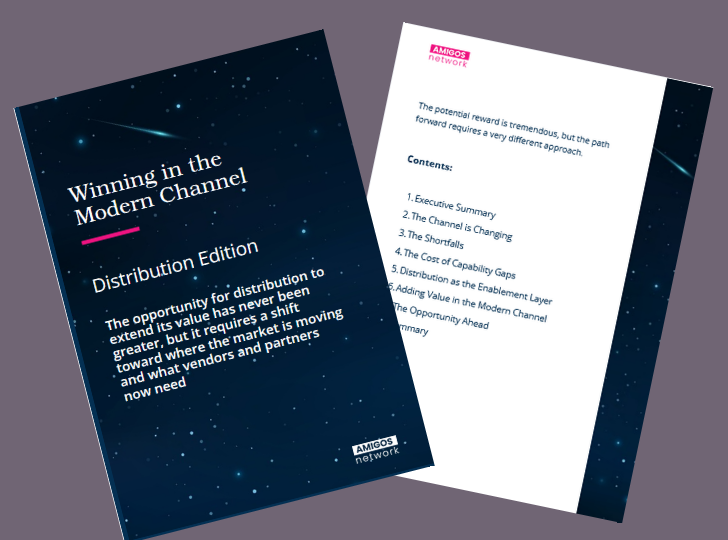
This paper explores that challenge from a distribution perspective.
It outlines where visibility breaks down, why traditional models fall short, and how distribution can move beyond operational enablement to become the layer that connects vendor investment, partner capability, and measurable pipeline.