
Editorial
The Real Value of Professional Services
Knowing when to call in the Cavalry and when your team is best placed to lead the charge
Professional services are often presented as the answer to every difficult technology project. Buy the software, add a block of consultancy days and let someone else take care of the complicated bits.
Sometimes that is exactly the right approach. Other times, it is an expensive way of avoiding decisions that should be made internally.
The real value of professional services is not simply access to people with technical skills. Most established resellers, integrators and end-user organisations already employ capable technical teams. The problem is that those people may not have the bandwidth, specialist expertise or relevant experience to deliver a particular project at the point it is needed.
A security team might understand Microsoft’s ecosystem but have limited experience implementing Purview. An infrastructure partner may be comfortable with networking but lack the skills to remediate a complex Fortinet deployment. A defence contractor might need a consultant who understands Trellix SIEM and holds the necessary security clearance.
Recruiting permanent employees for requirements like these rarely makes commercial sense. The need may last 15, 30 or 40 days rather than several years. Even where the requirement is longer term, finding and retaining the right technical specialists can take months.
Professional services can fill that gap quickly.
The channel’s hidden capability
Many customers assume that large resellers deliver every project using their own employees, but actually, much of the channel relies on specialist professional services companies.
Some engagements are completely white-labelled, with the technical consultant operating under the reseller’s brand. Others are delivered openly through an approved technical partner. The customer may know exactly who is providing the expertise, while the reseller continues to own the commercial relationship.
There is nothing inherently wrong with either model, the only thing the customer is interested in is the best way to get what they want and not be bothered with an organisation chart. What matters is that responsibilities are clear and the people delivering the work are properly qualified.
Customer excellence, without the overhead
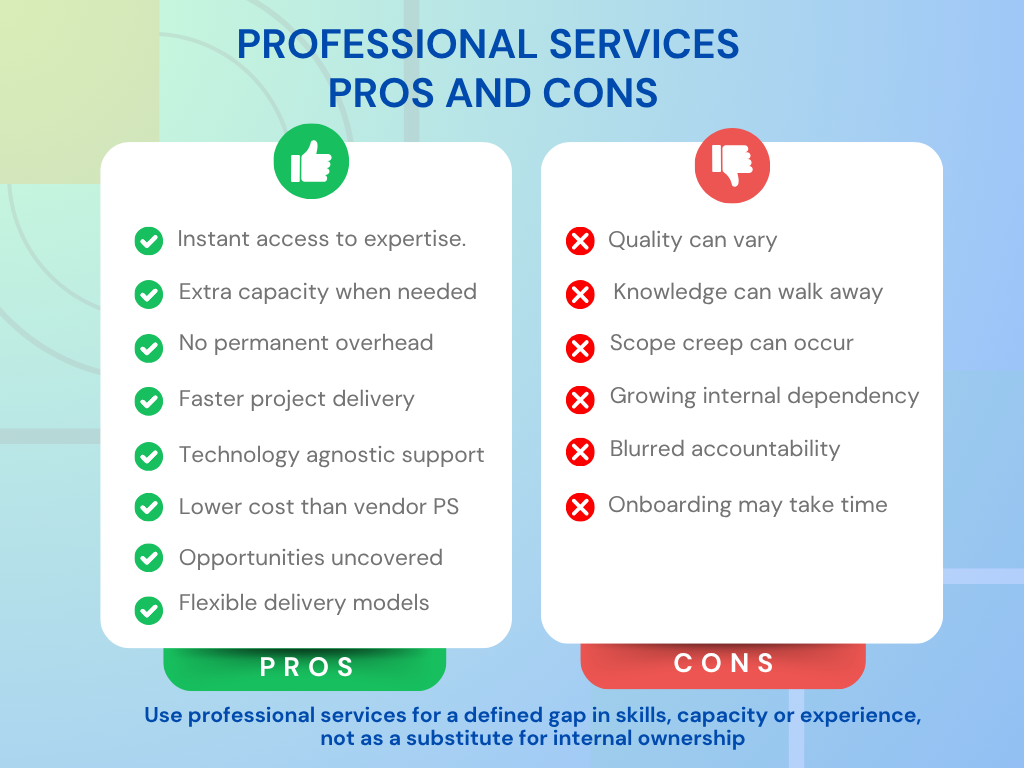
Using Professisonal Services allows partners to support a far broader range of customer requirements without carrying the cost of maintaining permanent expertise across every vendor and technology. It can also be considerably more cost-effective than defaulting to vendor professional services.
There is another commercial advantage: specialist consultants often identify related problems or opportunities once they enter the customer environment. What begins as a firewall upgrade might uncover VPN vulnerabilities, configuration issues or wider network requirements. This can create valuable follow-on work, provided it is handled transparently rather than treated as an excuse to inflate the original project.
Where it can go wrong
External expertise is not automatically the right answer. Professional services become poor value when the scope is vague, the desired outcome has not been agreed or the consultant is being used to compensate for weak internal ownership. Adding more experts to a project does not fix unclear decision-making.
There is also a risk of dependency. If knowledge remains with the consultant, the customer or partner may be unable to manage the technology once the engagement ends. Documentation, training and knowledge transfer should therefore be part of the project, not optional extras discussed during the final week.
Quality can also vary. A provider claiming to be technology-agnostic still needs to demonstrate relevant experience for the specific engagement. References, certifications and security clearance matter, but so does evidence that the proposed consultant has delivered comparable work in a live environment.
Professional services may also be unnecessary where the requirement is predictable, continuous and central to the organisation. If the same expertise is needed every week, building an internal capability or adopting a managed service may provide better long-term value.
Use expertise with a purpose
The strongest professional services engagements begin with a clearly defined gap. That might be missing expertise, insufficient capacity, an underperforming platform, a deployment deadline or the need for independent technical guidance.
The engagement can then take many forms: a short project, a medium-term consultant, technical training, remediation work or an ongoing managed service. It may involve working alongside an incumbent provider, supporting an internal team or delivering through a trusted channel partner.
Professional services work best when they extend an organisation’s capabilities without replacing its accountability. Used well, they provide access to expertise that would otherwise be unavailable or uneconomical. Used badly, they become another layer of cost and complexity.
When skills, capacity or timescales are holding a project back, professional services can provide the expertise needed to move it forward. Define the outcome, choose the right specialist and make knowledge transfer part of the engagement, then put external expertise to work.
About the author
Shaun Stratford is an IT consultant with more than 25 years’ experience in sales and account management across the IT and communications industry. He helps channel partners expand their technical capabilities through flexible professional services, connecting them with specialist expertise for complex customer projects
CONNECT ON LINKEDIN